

Larry Fink, CEO of BlackRock, reportedly warned that if Zohran Mamdani’s policies make New York a less attractive place to do business, BlackRock could look beyond New York City.
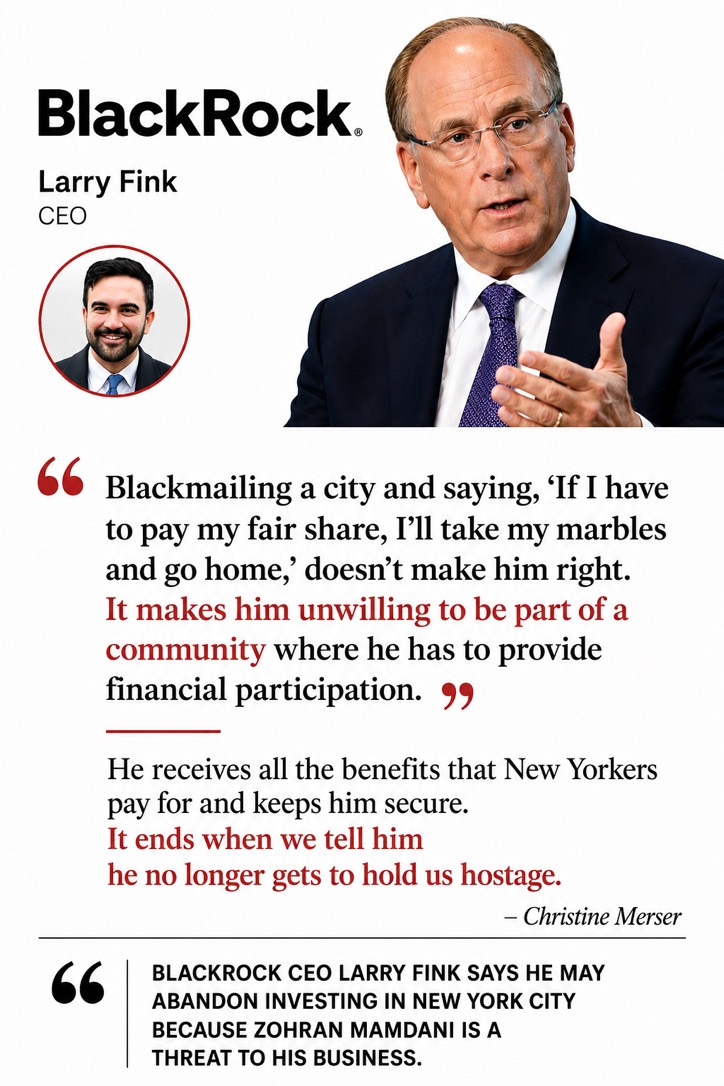
My first reaction wasn’t outrage. It was curiosity.
I realized I hadn’t asked the most important question. What exactly does Larry Fink mean when he says Zohran Mamdani is a threat to BlackRock’s business?
Is he arguing that BlackRock can no longer be profitable in New York? That the city’s financial infrastructure will collapse? That it will no longer be able to attract talent? Or is he saying something we’ve heard from corporate America for decades: if government asks us to contribute more to the communities that made us successful, we’ll simply leave.
Those are very different arguments, and America has become remarkably bad at asking people to explain themselves before we rush to defend or condemn them.
If Larry Fink believes Mamdani’s policies will genuinely damage New York’s economy, then let’s have that debate. He has earned the right to make his case. But if the underlying message is, “Ask me to pay more and I’ll invest somewhere else,” then I don’t find that persuasive. I find it familiar.
For decades, America’s largest corporations have negotiated with cities from a position of extraordinary leverage. They have sought - and received - tax abatements, subsidies, infrastructure improvements, and regulatory advantages, all while reminding elected officials that they are free to leave if they don’t like the terms. We accepted those negotiations because we feared losing jobs. We feared losing investment. We feared losing prosperity.
Or worse, because the elected officials were on the corporate payroll through campaign contributions, and perks, and in some cases, outright payoffs.
In hindsight, perhaps we should have been asking a different question.
What happens to a society when the wealthiest institutions can continually negotiate their obligations downward while everyone else continues paying for the schools, police, firefighters, sanitation, parks, transit systems, and public spaces that make those communities worth living in? What happens when the burden of maintaining a city slowly shifts away from those most able to bear it and onto everyone else?
I would argue we’ve been living with that answer for years. The widening gap between the very rich and everyone else did not appear overnight. It was built one concession at a time. Every time a corporation suggested it might leave, we blinked. Every time we accepted the premise that keeping capital happy was more important than asking it to participate fully in the communities from which it profits.
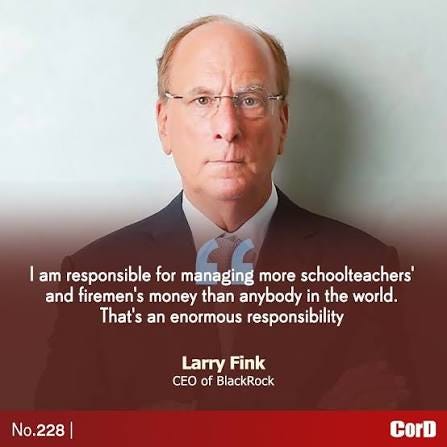
There is an irony here that is difficult to ignore. Larry Fink has spent years talking about stakeholder capitalism, about the responsibility corporations have to society and the importance of thinking beyond quarterly earnings. I have agreed with much of that philosophy. But stakeholder capitalism cannot become a one-way obligation. It cannot mean celebrating community until the community asks you to contribute more to sustaining it.
Communities are partnerships. They create the workforce, the legal systems, the infrastructure, the public safety, the transportation networks, and the stability that allow companies to thrive. Asking successful corporations to participate in paying for those things is not punishment. It is membership.
Larry Fink has every right to oppose Zohran Mamdani’s policies if he believes they are bad for New York. What concerns me is something different. It is the suggestion that the appropriate response is to threaten to leave. That is no longer an economic argument. It is an exercise of power.
Perhaps this is where America needs to change.
Perhaps the next time one of our largest corporations says, “If you don’t like our terms, we’ll take our marbles and go home,” the answer should simply be, “We’re sorry to see you go. But you will have to find another piece of asphalt on which to play your marbles.”
Communities were never created to serve corporations. Corporations exist because communities do.
Somewhere along the way, we forgot that. America Interrupted is, in many ways, the story of how we got here, and whether we still have the courage to remember what a community is supposed to be.
Call Larry out on his threats. Do it publicly.
America doesn't run on stakeholder capitalism, but vulture capitalism. That also explains the current situation and corporate leverage.