
Corruption of the Best is the Worst of All. Behind the Scenes in the NYC Mayor's Race.

“Corruptio Optimi Pessima,” latin translating to “the corruption of the best is the worst of all.” I first saw it in on The West Wing. The line is delivered by President Bartlet in reference to a story about soldiers who died for their comrades, implying that their sacrifice should be honored through a life of integrity. It has stayed with me and my politics ever since.
It’s only been 36 hours since Zohran Mamdani, who I supported from the beginning, won the New York City mayoral election. And he didn’t just win it. He won it big. He won it without the backing of big money. Many millions, we’ll probably never know how many, were spent to try to stop him. He was unstoppable. I’ve already received numerous inquiries asking what I think happened behind the scenes of this campaign.
I’ve been thinking about it since Mamdani won the primary and the old guard went behind the scenes to bury him.
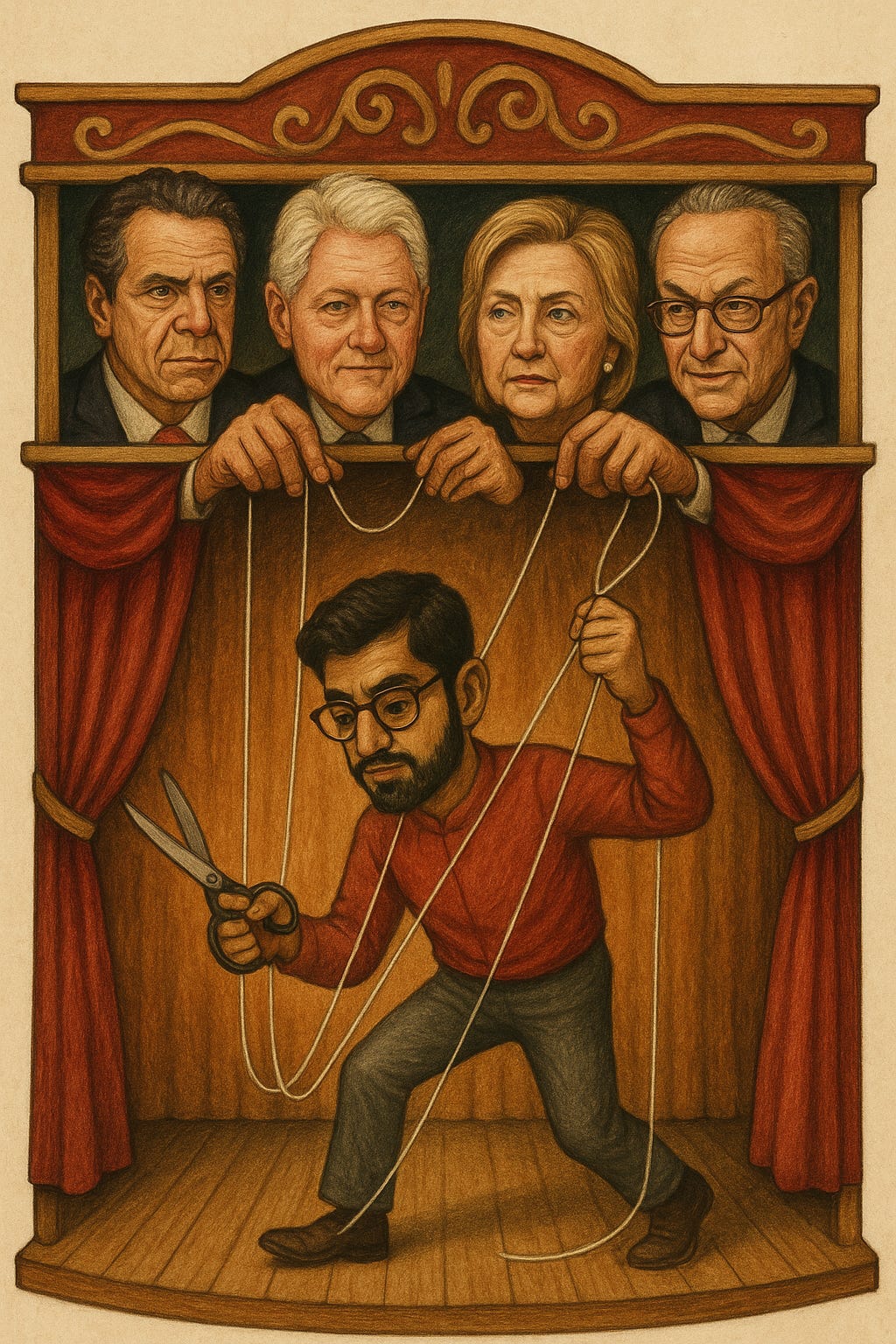
It’s time to say it out loud. The corruption problem in politics is not unique to Republicans. Within the Democratic Party, the rot looks different, maybe it dresses better, but it works the same. It hides in networks of money, in quiet exchanges of power, in a culture that rewards loyalty and punishes disruption. When Zohran Mamdani ran for mayor of New York City, many of the party’s most recognizable figures, people who have built entire careers on speaking for progress, chose silence, or worse, they tried to make him lose. They should have stood with him. They didn’t. The question isn’t just why. It’s what, underneath all the excuses, kept them from doing it.
The Money Networks and the Cuomo IOU
When you see names like Bill and Hillary Clinton or Andrew Cuomo attached to a campaign, you’re looking at decades of alliances built around donors, law firms, and real estate power. Endorsing Mamdani wasn’t a gesture. It would have been a message, that the old track is ending. For many, that was too much. The Clintons backed Cuomo because the ecosystem they helped build depends on the same donors Mamdani wants to tax. It wasn’t about ideology. It was about protecting a network that has kept them all comfortable for years.
Schumer, Israel, and Identity Politics
Power is not only about policy. It’s about wiring. Chuck Schumer’s identity and donor base are tied to his pro-Israel stance. Mamdani’s unapologetic criticism of Israel’s government made Schumer’s position impossible. Endorsing him would have opened a flood of attack ads, donor backlash, and outrage from the establishment. He chose silence. For Schumer, this wasn’t about one race. It was about legacy. If the party’s future looks more like Mamdani, that means Schumer’s era is over.
The “S Word” Hangover
Socialist. It used to mean belief in working people and fair distribution of wealth. Now it’s treated like a political curse word. Mamdani reclaimed it. That terrified Democrats who’ve spent thirty years building a centrist brand. Endorsing him would have risked every big donor and every swing voter they think they still need. It also would have meant confronting an uncomfortable truth, that if a self-declared socialist governs successfully, the word loses its sting, and the middle loses its power.
Real Estate, Business, and the Quietly Powerful
The people who really fund New York politics don’t hold office. They sit in boardrooms and own towers. They fund campaigns and foundations. Mamdani’s agenda, taxing millionaires, freezing rents, creating city-owned grocery stores, terrifies them. For Bill and Hillary Clinton, for Schumer, for every establishment figure who depends on those same donors, backing Mamdani would have been self-sabotage. They looked at him and saw a financial threat to the very people who keep them in motion.
You know who gave millions to defeat Mamdani after the primary? Just a few of the names to give you a moment of pause. What did they want to gain?
The Lauder Family. ($2.6 million)
Michael Bloomberg. Millions. Not sure how many. But at least $13.5 million.
Bill Ackman ($1.75 million)
Laurie Tisch ($250,000)
Machine Instinct and Power Maintenance
Inside the Democratic Party lives a machine. You can’t always see it, but you can feel it when someone challenges it. Mamdani didn’t play by the rules. He built a campaign around volunteers and small donations. That is not how the system works. The machine relies on control and favors. It rewards those who wait their turn. When someone wins without them, the machine reacts with hostility.
Barack Obama once did the same thing. When he entered the 2008 race, Hillary Clinton had already locked up nearly every major Democratic donor except George Soros. So Obama turned to the internet, building a new model powered by small contributions from ordinary people. It was revolutionary. For the first time, a candidate used grassroots online fundraising to take on the establishment and won. But once in office, he folded back into the institution he had disrupted. The lesson for the party was clear. If someone breaks the machine, bring them inside it before they do lasting damage.
That’s why Mamdani frightens them. He’s not looking for entry. He’s not waiting for permission. And they know that if he succeeds without the machine, others will follow.
Generational Control and the Fear of Being Replaced
Mamdani is in his thirties. That alone is enough to shake people who built careers on slow climbs and safe moves. His win says you don’t have to wait for permission. You can rise through energy, connection, and message. For the elders of the party, that’s not inspiring, it’s existential. It means the ladder they built might not matter anymore. They didn’t stay quiet because they disagreed with him. They stayed quiet because he reminded them their time might be over.
The Unspoken Bias and the Electability Panic
No one will say it out loud, but it matters. Mamdani is Muslim. A child of immigrants. A democratic socialist. For some, that combination triggered quiet panic. Not because they believed he was unfit, but because they imagined the headlines if anything went wrong during his term. They worried about perception, about right-wing media, about their donors’ unease. Electability became the polite word for prejudice. They feared being tied to him if things turned ugly.
Public Safety Fears and Consultant Caution
Consultants run modern politics. They live in poll numbers and crisis simulations. They know one rule, never give Republicans an easy ad about crime. Mamdani’s approach to policing and public safety was bold, reform-minded, and risky to their model. The consultants told the establishment, stay quiet. If crime ticked up, the sound bite “Socialist mayor fails to protect the city” would run for years. They chose silence over courage, strategy over conviction.
They Thought He Didn’t Need Them and He Couldn’t Punish Them
Once Mamdani’s campaign took off, the calculation changed. He was winning. They realized he didn’t need their endorsements to succeed, and if he won, he wouldn’t have power to hurt them. So they waited. They let him climb on his own and planned to congratulate him afterward. It was politics at its most self-serving. Their silence wasn’t neutral. It was opportunistic.
The Socialist Blueprint’s Threat to the Center Left Business Model
This is the core of it. Mamdani is redefining socialism back to its original form, working for the people, not the powerful. That threatens everything the Democratic establishment stands on. The consultants, the fundraisers, the lobbyists, the entire corporate-friendly framework that runs under the surface of the party. If he governs well, if life in New York improves under his watch, it exposes their model as outdated. The silence wasn’t fear of failure. It was fear of proof that the future doesn’t need them.
What happens now matters as much as the win itself. Mamdani didn’t just win. He won big. That wasn’t a fluke or a protest vote. It was a mandate. A clear rejection of the old machinery that told New Yorkers to be grateful for scraps while the cost of living soared and trust in leadership collapsed. His victory says people are ready for something else, something bolder, something that doesn’t come from a boardroom memo or a donor brunch.
The question is whether the party can absorb that message or if it will spend the next four years quietly trying to make him fail. They will call it course correction, balance, protecting the brand, but it will be sabotage in better clothes. The truth is, they might still have the power to slow him down. But not for long. Every time he delivers on one of his promises, on housing, on transit, on affordability, he rewires what voters think is possible.
Some of his policies could work, and if even a few do, they’ll shift the ground under the Democratic Party. If a socialist mayor can govern New York with competence and compassion, the argument that you have to choose between bold ideas and good management disappears. That’s what they fear most. Not chaos, but competence.
So yes, they may still pull strings behind the curtain. But the curtains are thinner now. The party that built its empire on fear of losing control is running out of rooms where it still controls the lights. Mamdani’s win didn’t just change a city. It may have marked the beginning of the end of the party as we’ve known it, and the start of something braver, finally ready to live up to its own rhetoric about change.
Extraordinary analysis!!