
It's SO NOT Trump

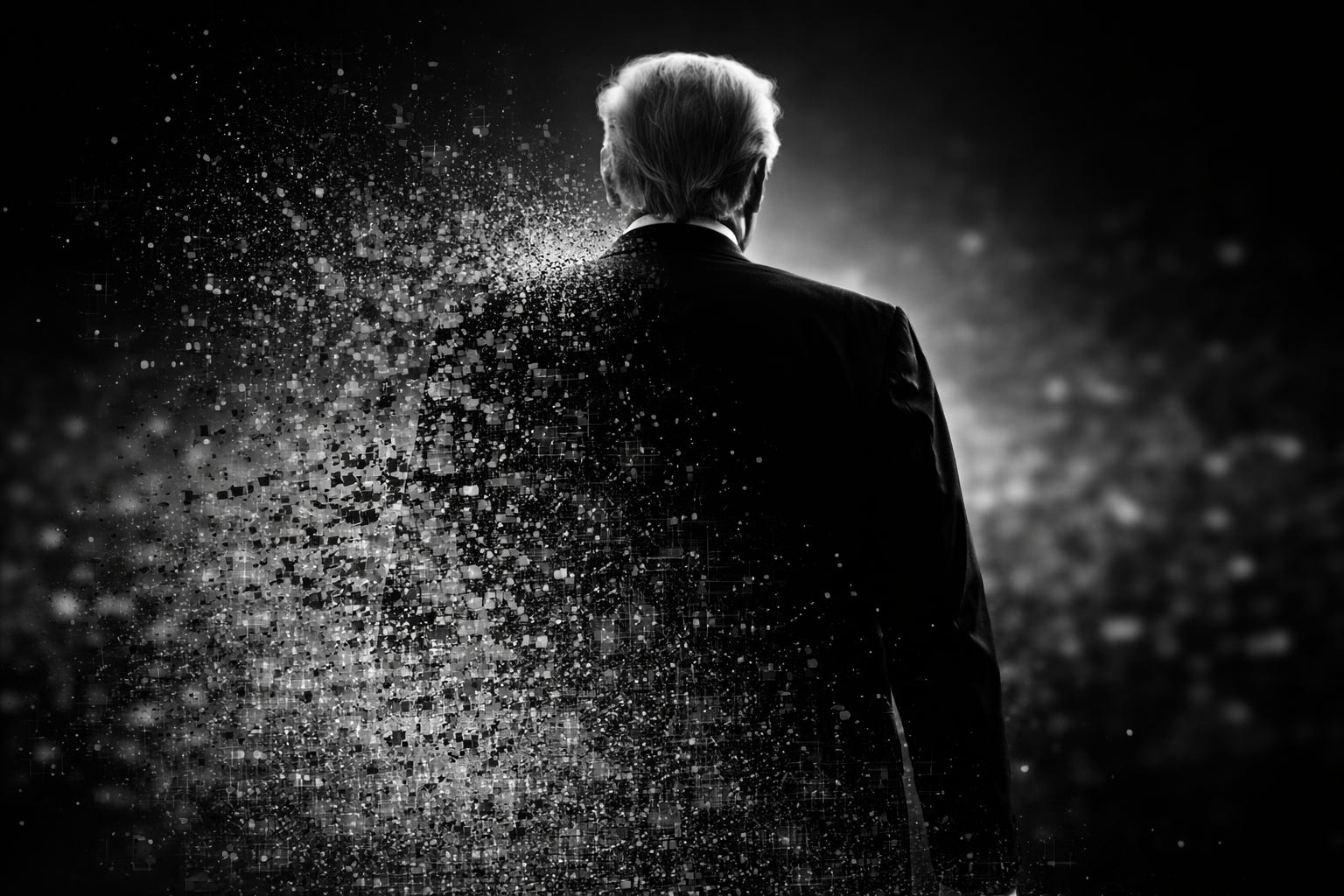
I’ve spent years talking about Trump. Writing about him. Reacting to him. Trying to understand him. Warning about him. I understand the impulse because I’ve lived inside it. He is loud. He is offensive. He is a spectacle engineered to pull oxygen out of every room he enters.
After he was re-elected, I stopped talking about him, clicking on anything with his name or face and begging friends and family to stop. They haven’t. I ignore anything they send me that has his name front and center. They still send it.
I’ve come to believe that continuing to center Trump is not just unhelpful. It is actively obscuring the real danger.
Trump is no longer the issue. And in many ways, he hasn’t been for a long time.
Focusing on Trump personalizes a problem that is structural. It suggests that if one man were removed, disgraced, defeated, or silenced, something essential would be resolved. That belief has been comforting, but it has also been false. Trump did not invent the conditions we are living under. He exploited them, benefited from them, and revealed them. But the machinery that elevated him did not disappear when he left office, and it will not disappear when he eventually exits the stage.
And, worse, they use him to obstruct our view.
Trump functions as a kind of decoy. As long as our attention stays fixed on his words, his legal troubles, his rallies, his insults, we are spared from having to look directly at the systems that reward his behavior and replicate it in quieter forms. Outrage becomes a substitute for analysis. Disgust becomes a substitute for accountability.
There is relief in having a villain with a face.
What I see now is that Trump absorbed so much attention that he shielded the underlying architecture from scrutiny. The media ecosystem that monetizes outrage did not begin with him and does not depend on him. The erosion of institutional guardrails did not start with him and will not end with him. The global flow of money, influence, grievance, and disinformation that sustains this moment predates Trump and will outlive him.
Trump didn’t create the incentives. He followed them.
That distinction matters. Because when we frame the problem as Trump, we implicitly frame the solution as removal. Vote him out. Prosecute him. Deplatform him. Shame him. And while some of those actions may be necessary or justified, none of them address the deeper reality: the system that elevated him remains intact.
Worse, Trump-centric focus has trained us to look for danger only when it arrives as spectacle. We are alert to the outrageous statement, the shocking headline, the theatrical cruelty. Meanwhile, the quieter work continues. Courts reshaped incrementally. Norms hollowed out legally. Expertise displaced by loyalty. Media incentives recalibrated around engagement rather than truth. Power redistributed into networks that do not require a single leader to function.
Trump is not the engine of that system. He is a product of it.
And that is why removing him does not dismantle it.
I’ve also had to confront something more uncomfortable. Focusing on Trump gave me a sense of moral clarity without requiring sustained engagement. I knew where I stood. I knew what I opposed. I could measure my vigilance by my reaction to him. That focus was emotionally satisfying. It was also incomplete.
The truth is that the most consequential shifts happening now do not require Trump’s presence at all. They move through courts, markets, platforms, legislatures, and bureaucracies. They are advanced by people who never raise their voices, never break norms publicly, never become household names. They do not need rallies. They need compliance. They do not need devotion. They need participation.
Trump made power visible. What we are dealing with now has made power ambient.
That is why continuing to center Trump actually makes it harder to respond to what is unfolding. It keeps us oriented toward a personality when we need to be oriented toward a pattern. It keeps us arguing about a man when we should be interrogating incentives, structures, and global alignments that operate whether he is present or not.
Trump is useful to the system precisely because he draws fire.
At some point, staying focused on him becomes a form of avoidance. It allows us to believe that the threat is singular, personal, and temporary. It allows us to postpone the harder work of naming what has already taken hold.
The real question is not what Trump will do next.
The real question is why so many systems no longer require him at all.
FOR SURE the problem is so much wider/pervasive than just one silly little man. It is a national disgrace that support for nationwide bullying by the ICE Gestapo is so extensive. SHAME ON AMERICA, the formerly beautiful and formerly land of the free.