
Lindsey Graham’s Death Ends One Political Era. Let It Be the Start of Another.
Annie Andrews can win the election in November in South Carolina.

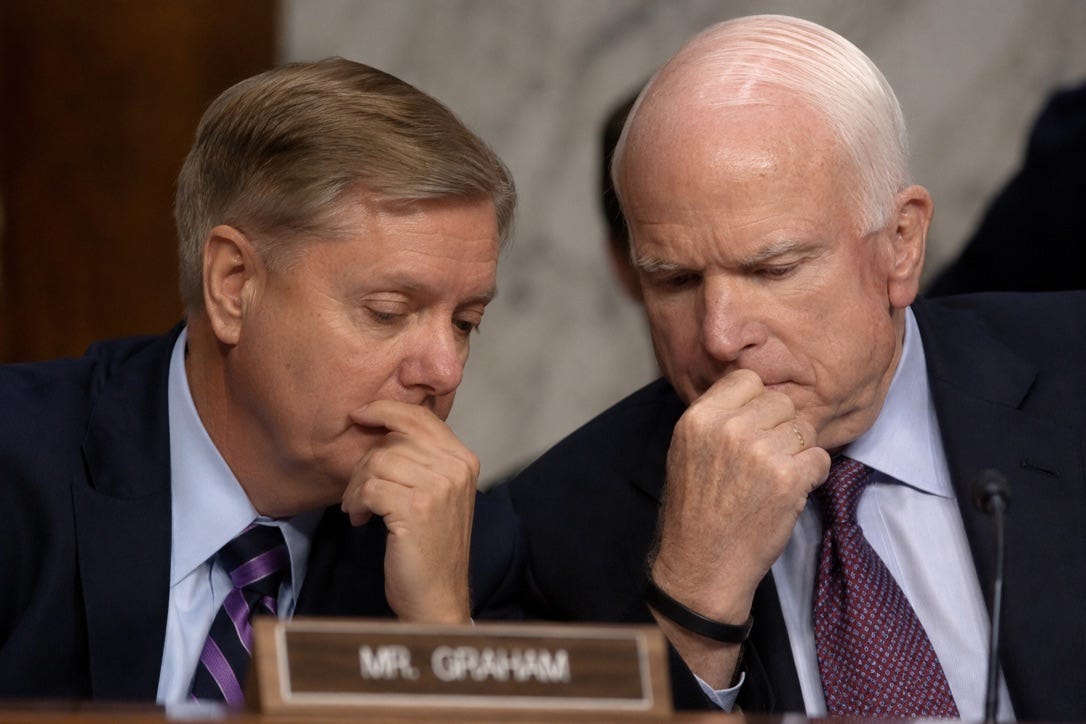
My first thought wasn’t Donald Trump.
It was John McCain.
For years, Lindsey Graham and John McCain were inseparable. They represented a Republican Party that believed America’s alliances mattered, that national security wasn’t be a talking point, and that friendships across the aisle were not signs of weakness. Whether you agreed with them or not, they were a team.
McCain’s death in 2018 marked a turning point in Graham’s career. The senator who had once been one of Donald Trump’s harshest critics became one of his strongest allies. Political observers will spend years debating why that happened and whether it was strategy, survival, conviction, blackmail, or simply the evolution of a man trying to remain relevant in a party that was changing around him.
History will decide. Not my problem.
But Lindsey Graham’s death doesn’t simply end one of the longest-serving Senate careers in modern South Carolina. It immediately creates one of the most interesting political opportunities of the 2026 election.
The first step is predictable.
Under South Carolina law, Governor Henry McMaster will appoint a Republican to fill the vacancy until voters elect someone to complete the remainder of the term. That appointment is almost certain to come from within the Republican Party.
The names will begin circulating immediately. Nancy Mace. Ralph Norman. Alan Wilson. Others with statewide ambitions. Whoever receives the appointment will immediately become one of the most influential political figures in the state.
But that’s only half the story.
The real story is November.
Lindsey Graham wasn’t simply another Republican nominee. He was an institution. He had spent decades building relationships, raising money, organizing supporters, and becoming one of the best-known political figures in South Carolina. Whoever ultimately carries the Republican banner inherits the nomination, but not Lindsey Graham’s political capital.
That changes the race.
If Democrats are smart, they won’t dismiss South Carolina because of its history. They’ll do exactly the opposite.
They’ll flood it.
Every national donor should take another look. Every strategist should ask whether this is suddenly a state worth investing in. Every volunteer should consider whether this is the race no one expected to matter.

Democrats already have a nominee in Dr. Annie Andrews. Rather than searching for another candidate, they should unite behind the campaign that’s already in place and move immediately.
At this point, I’m going to put on my political strategist hat.
If I were advising Dr. Annie Andrews this morning, I wouldn’t tell her to run as a Democrat. For God’s sake, she’s a pediatrician. She can appeal to everyone.
But, I’d tell her to run as a South Carolinian.
I’d look into the camera on day one and say:
“I’m proud to be the Democratic nominee, but this campaign isn’t about Washington. Or the nation. It’s about South Carolina. I don’t wake up every morning thinking about the Democratic Party or the Republican Party. I wake up thinking about the people who call South Carolina home.”
Then I’d tell her to spend the rest of the campaign talking about only three things.
First, make life more affordable. South Carolinians are worried about the cost of groceries, housing, insurance, and simply getting through the month. Every speech should begin and end there.
Second, protect and expand healthcare. As a pediatrician, Annie Andrews has credibility that no consultant can manufacture. Rural hospitals are closing. Families struggle to find physicians. Healthcare isn’t an ideological issue when your nearest emergency room is forty-five minutes away.
Third, ask the citizens, all of them to build the next generation of South Carolina. Better schools. Better workforce training. Better roads and infrastructure to keep up with one of the fastest-growing states in the country. Make the argument that growth is only good if families can keep up with it.
And if reporters ask about abortion, immigration, or whatever controversy is dominating cable television that day?
I’d answer the same way every single time.
“Those issues will be debated in Washington and, in many cases, decided by the courts. The people of South Carolina didn’t hire me to become another cable news commentator. They hired me to fight for their families, their jobs, their healthcare, and their future. That’s what I’m going to talk about.”
Candidates lose campaigns because they allow their opponents to choose the battlefield.
Great candidates choose it themselves. And, then they have the discipline to stay inside the lines. Mamdani did it with Israel. The first mayoral candidate to win every single borough. The playbook is there.
Now let me take off my campaign strategist hat and put on my national political strategist hat.
If I were advising the Democratic Party this morning, my message would be just as simple.
Flood South Carolina. Money. Money Money.
**********************************
Click here and follow her on all her media, send a contribution today, and start posting to get the rest of the nation who hopes to see America’s Interruption interrupted.
Here is her YouTube introduction video. She’s good. You will see it immediately.
**********************************
Every national donor should be making calls. Every organizer should be booking flights. Every volunteer should be looking at a map. This isn’t because South Carolina suddenly became a blue state.
It’s because Lindsey Graham was never just another incumbent.
He was the incumbent.
He spent decades building relationships, raising money, organizing supporters, and creating a political machine that cannot simply be handed to someone else overnight.
Whoever replaces him inherits the Republican nomination.
They do not inherit Lindsey Graham.
Will Democrats win?
History says probably not. I say it’s so possible.
Politics is about probabilities until it suddenly isn’t.
Every election has moments that reshape the map. An unexpected retirement. A scandal. A recession. A war. Or the sudden loss of an incumbent who seemed almost impossible to replace.
This is one of those moments.
Even if Republicans ultimately hold the seat, forcing them to invest millions of dollars and countless hours in South Carolina changes the national landscape. Every dollar spent defending South Carolina is a dollar not spent somewhere else. Every strategist focused on Columbia is one less strategist focused on another competitive race.
Sometimes politics isn’t about winning one battle.
It’s about changing where the other side has to fight.
There is an even larger question.
For decades, American politics has been dominated by the same names—McConnell, Pelosi, Graham, Schumer, Biden, and Trump. Whether you admired them or opposed them, they defined an era.
One by one, they are leaving the stage. Please God let Schumer go next, but that’s another column.
The question isn’t simply who replaces Lindsey Graham.
The question is whether American politics still produces senators whose influence is measured over decades, or whether every seat has become another battle in a permanent campaign where longevity has been replaced by constant disruption.
South Carolina may be about to give us the answer.
There is one final thought I can’t shake.
When John McCain died, something seemed to change in Lindsey Graham. Commentators will debate for years whether it was political calculation, loyalty, ambition, survival, conviction, or simply the cost of trying to remain relevant in a party that had fundamentally changed. We may never know.
What I do know is that the Lindsey Graham who stood beside John McCain felt different from the Lindsey Graham America came to know over the last decade. Whether that change came from conviction or compromise is a question only he could answer.
We are never the best thing we ever did, and we are never the worst thing we ever did. Human beings are more complicated than that.
I don’t know what ultimately ended Lindsey Graham’s life. But I do wonder if the version of him that so many people admired disappeared long before today.
If that’s true, it’s a tragedy, not just for American politics, but for him.
Wherever he is now, I hope he has found the peace that seemed so elusive during his final years.