
McConnell. Kennedy. Roosevelt. Reagan.
Hiding the truth about DC's elected officials is not new.

The government hiding things from the American people is not new.
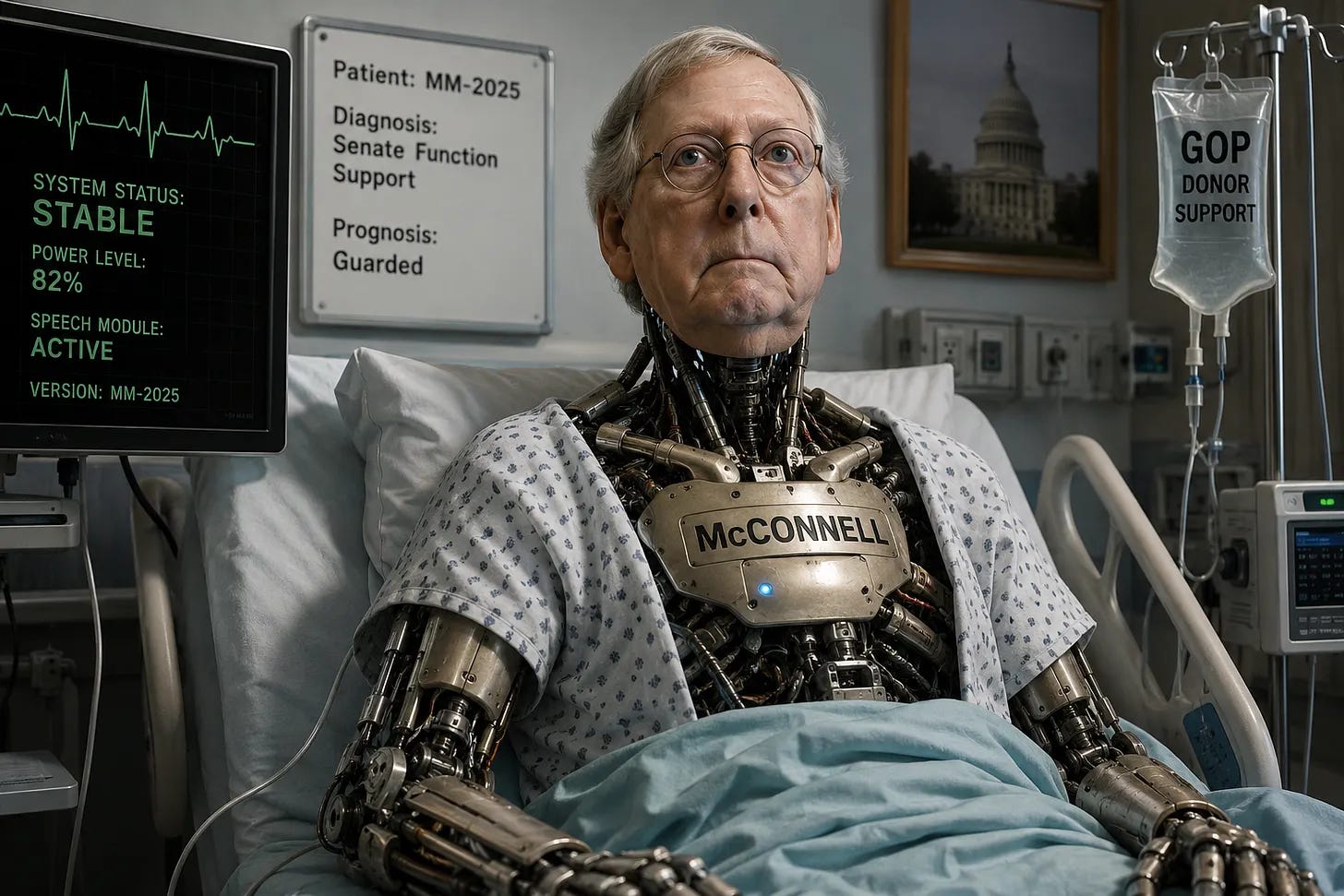
.
If anything, it’s one of our oldest traditions.
Franklin Delano Roosevelt spent twelve years as President of the United States. He led the country through the Great Depression and World War II. He was one of the most photographed men on Earth.
And somehow, remarkably, America almost never saw him in his wheelchair.
It wasn’t because he wasn’t using one.
He used it every day.
The White House choreographed appearances with the precision of a Broadway production. Podiums were built so he could brace himself and appear to stand. Steel leg braces locked his knees. His sons and aides quietly held him upright. Secret Service agents discouraged photographers from taking the pictures the administration didn’t want taken, and the press largely went along with it.
Today we’d call it media management.
Back then they called it Tuesday.
Americans knew Roosevelt had contracted polio. What they didn’t appreciate was just how completely he depended on that wheelchair because the people around him made sure they rarely saw it.
Then came John Kennedy.
Camelot. Youth. Strength. Football on the lawn. The mirror of a youthful America rising, rising, rising.
The picture was of a vibrant young president who looked as though he could outrun half the White House staff.
Reality was a little different.
Kennedy lived with excruciating back pain, wore a rigid back brace, relied on powerful medications, and was treated by more doctors than some small towns have residents. Much of it stayed out of public view because preserving the image was considered part of preserving the presidency. And, then of course there were the women in and out.
Then Ronald Reagan.
His Alzheimer’s diagnosis came years after he left office, but historians still debate whether signs of cognitive decline may have begun while he was president. The point isn’t to settle that debate. The point is that every administration eventually becomes the subject of questions about what was known, when it was known, and who knew it.
Apparently, Washington has always preferred mystery over transparency.
But, then Joe Biden came along, and the pendulum swung so hard it nearly snapped. Every stumble became breaking news. Every hesitant answer was analyzed frame by frame.
If he reached for a handrail, there would be three neurologists, two former campaign managers, a body language expert, and someone’s cousin on YouTube explaining what it meant before dinner.
For Roosevelt, they hid the wheelchair.
For Biden, they practically measured the angle of his shoelaces.
Which brings me to Mitch McConnell.
I’m not making an accusation. I’m making an observation about the world we’ve built.
For the first time in history, technology has caught up with politics.
Artificial intelligence can clone voices. It can learn speech patterns. It can carry on conversations convincing enough that many people wouldn’t know the difference.
Is that happening with Mitch McConnell?
I have no idea.
But here’s the question nobody could have asked during Roosevelt’s presidency:
Could someone believe they’re speaking to a public official on the phone when they’re actually speaking to an AI system or another surrogate?
The answer is yes.
Not because I think that’s what’s happening. Because that’s where the technology is.
Which makes one thing increasingly strange.
If Mitch McConnell is perfectly capable of speaking directly to the American people, why not simply put him on camera?
Not a carefully cropped photograph.
Not another written statement.
Not “sources close to…”
Just a camera.
In 2026, that’s about the easiest mystery in Washington to solve. The technology exists to fake almost anything.
Ironically, the easiest way to silence the speculation is also the oldest.
Turn on the camera.