

“We are not waiting for leadership. We are hiding behind the idea of it.” - Christine Merser
I moved from Maine to New York last week. In four days, I packed up my entire life and started over. It’s been a week.
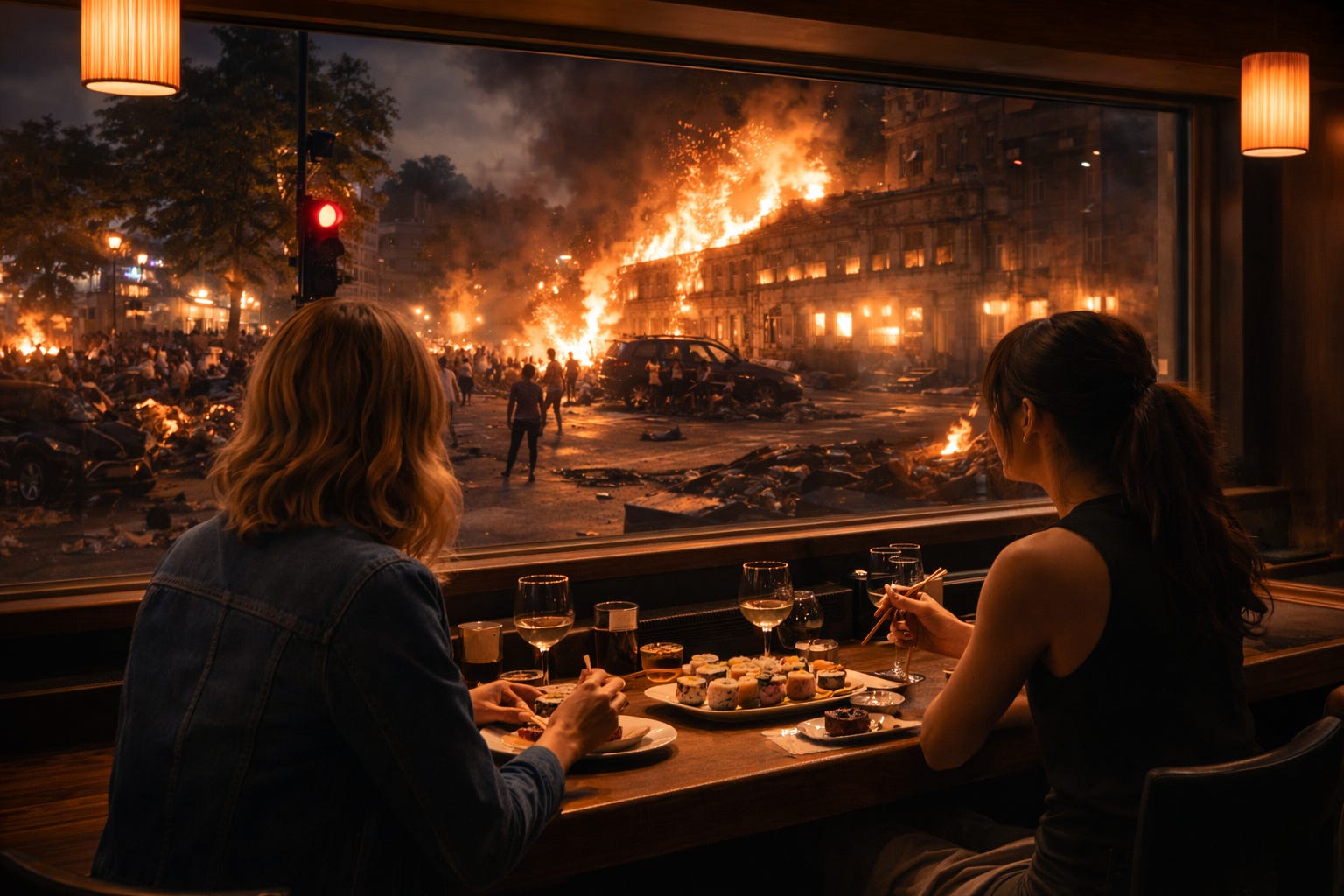
Last night, I picked up my sister at 5:30 and we went for our Tuesday night ritual, sushi at the bar.
We talked about the move. We talked about an upcoming family wedding. And then we talked about Iran, and the Armageddon that was supposed to arrive in three hours, while we sat there eating sushi.
In Iran, as I understand it, young people were preparing to hold hands and circle electrical plants and other targets Trump had threatened to annihilate, fully aware that doing so could cost them their lives.
As far as I know, not one of us in America was lining up anywhere other than outside a movie theater.
Oh, there’s a lot of talk. Social media, Threads. X. Phone calls. Conversations at dinner.
“When are they going to stop him?”
And from all across the world, people are looking at us and wondering why we don’t understand who they is.
Why we aren’t circling the White House.
Why we weren’t marching all day today, demanding a session of Congress, demanding this stop.
Instead, most of the pundits are talking about how it’s up to the military to refuse to carry out the orders of the commander in chief. And, in the end, up to individual men and women to not carry out orders of distruction passed down from DT.
I looked into that.
The man or woman responsible for arming the drone, for pushing the button on the missile, makes approximately $50,000 to $70,000 a year. Every part of their training tells them to follow orders.
And this is our expectation?
This is not about Trump. He is a demented old man. When he is gone, I will echo his own words, “I’m glad he’s dead,” and millions, maybe billions, around the world will echo it too.
But this moment is not about him.
It’s about we the people.
We’ve lost our way.
Each and every one of us.
There is something quieter sitting underneath all of this, something we don’t like to look at.
We keep searching for a they because it allows us to stay seated, to stay safe, to stay removed. They is comforting. They is distance. They is the belief that someone else, somewhere else, will absorb the cost of action.
But history doesn’t work that way.
When people act, it is rarely because they are braver or stronger. It is because the distance between what they believe and what they are doing becomes unbearable. The tension closes in until action is no longer a choice but a release.
We are not there.
We are still comfortable enough to talk about war over sushi. To check our phones. To ask the question and move on to the next topic.
That is not apathy. It is something more complex. It is a learned dependence on systems, on structure, on authority, combined with just enough distance from consequence to keep us still.
We are waiting for a signal that will not come.
And until the discomfort of inaction outweighs the comfort of watching, we will keep waiting.
That is the real danger.
Not him.
Us.
So well said! UNSETTLING. Thank you for articulating this.