
Tatiana Kennedy Schlossberg. Thank you.

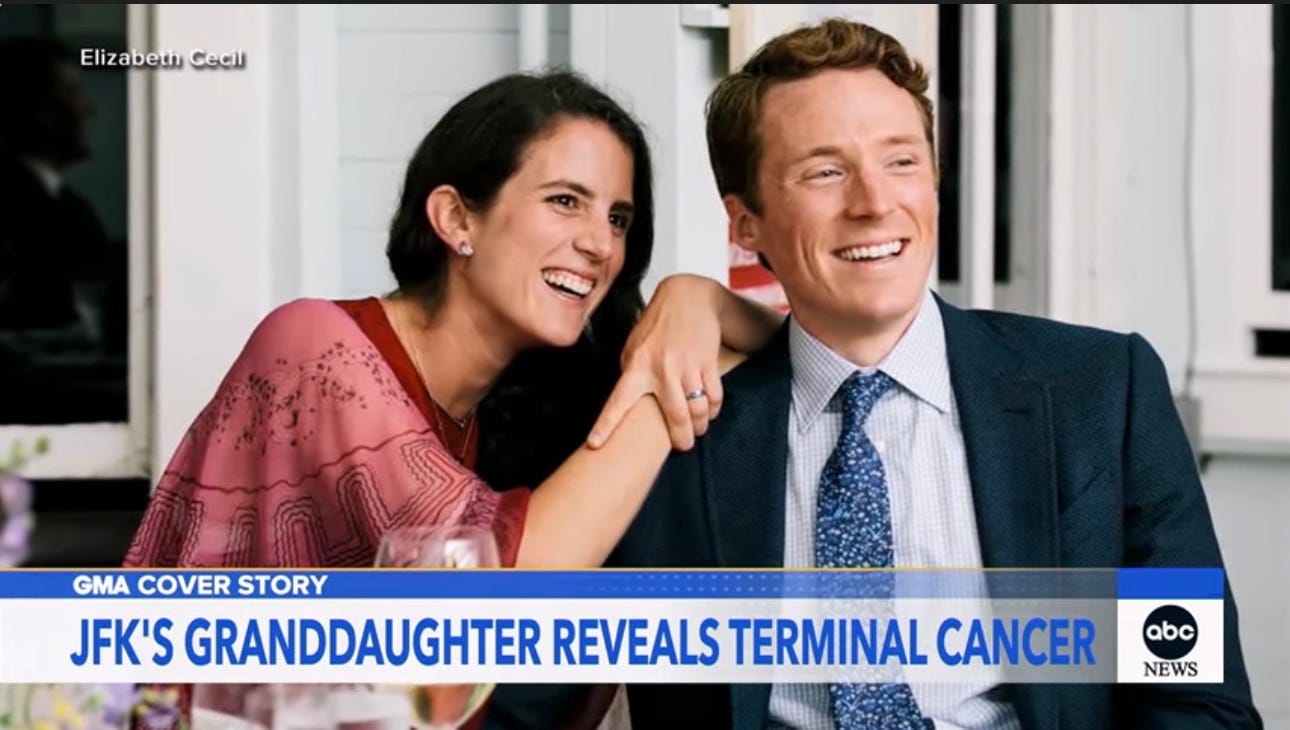
I think you would have to be living under a rock to not yet have heard about her or at least read part of Tatiana Schlossberg’s essay in The New Yorker about her terminal diagnosis.
I read a lot of essays. I write a lot of essays. I am pretty sure that is the best one I ever read.
Before I get to the essay itself, as a strategist who has done political strategy, I can tell you that the Kennedy family has often not had a chance to control the narrative of their own personal stories. Some of them are stories that had nothing to do with America or the work the Kennedy family members do as part of their service to their country. And when you do not control the narrative of your own story, there is a spiral of pain that comes from reading what others consider to be certain or somehow part of an inside track that they do not have.
I believe that Ms Schlossberg wrote this essay and put it out before any articles about her illness could surface so that she could control the narrative. If she never writes another word or speaks publicly to us about her situation, she has, in this breathtaking essay, told us every single thing about her life and the journey from giving birth eighteen months ago, when they discovered she had leukemia, through what is ahead for its certain ending.
Oh my God, the grace. The eloquence. The gentle way she lays out the story. Even the vulnerability of a simple sentence about her doctor, who she thanks for traveling to the end of the world to find a cure for her because he knew she did not want to die. She couches not wanting to die inside the heroism of her doctor, which gives us no doorway to pity. It is a Nobel literature prize kind of moment.
Tatiana herself is a journalist. She writes about the ocean and about what could be won or lost by what we do next in preserving or destroying it. Anyone who spends their career looking at the ocean is a deep thinker if you ask me. I think she worked very hard on this piece. I think it is a teaching piece about how to approach things we have no control over. She has shown a light for generations to come.
That is writing. No self pity. No invitation for us to wrap her in our arms and weep, because the truth is we do not know her and she is surrounded by her loved ones and that is their job, not ours. Our job is to take her lessons and then respect her privacy.
When John Kennedy Jr. and Caroline’s mother was dying, a woman got into 1040 Fifth Avenue, which was their building (and at one point mine), and somehow got up onto the floor. She was in the apartment and John Junior walked up to her and quietly but firmly said, “Madame, you do not belong here.” And he escorted her out.
Tatiana gave us every inch of her story so no one else could write it and take away one word or one minute of what she is going through.
I think we need to follow her lead. We need to stop posting about how sorry we feel for her and her family. That is not the essay I read. That is not what she wants. She does not speak from that place and if she has those moments they belong to her and not to us on social media.
And then she gets to the part about her uncle taking away the funding. With it went any chance for a possible answer that had not already been discovered for her situation.
I think that was when I realized that in 2025, with all the pain and fear and agony and rage and shock and discovery that this year has brought, this was the moment that felled me.
But in the middle of this amazing story of this amazing human being raised by an amazing mother and grandmother, she has to include her cousin Robert Kennedy Junior. A man who has no business working in healthcare in any way, let alone being in charge of stopping funding for life saving answers. Yet he gets to be part of her story. Because our country is so torn apart and so devastated by the destruction taking place on a daily basis, she has to add politics to her journey, which is difficult enough without any of it.
It was the last straw. I saw red. I felt the rage of a mother of a child myself who cannot imagine the impotence the mothers in that family must be feeling. And I turned it on politics.
And then I stopped myself cold and said I have no right to take any of her journey in any direction other than to thank her deeply for making me wake up to the realities of life and how you can choose to live both the living parts of it and the dying parts.
To think of her showing us grace that many of us could never hope to obtain in the enormity that she has found it.
And to tell her that I will not ask another question or read another article unless it comes from her because the rest of her journey she gets to do in privacy. And to tell her that she did good.
The part that I know, which is the piece that she wrote and that is all, she did good.
There are so many lessons in what she wrote and how she did it and how to approach the unfair destruction of everything around us, including her now fragile body that apparently was not fragile to start with.
One of the things she mentions is that she spent her life trying not to give her mother additional pain and suffering after her mother had already gone through so much. And she writes that she is sad to be in a position now where she cannot protect her.
My thoughts go out to Caroline and to the entire family. And my passion to mirror the way they both behave, no matter what is thrown on top of them, feels like the least we can do. To aspire to be more like them. Or maybe I should write my own story and say less like myself.
I will never forget what she wrote. I printed it out and it is in my hope chest to be read on occasion and she has immortality in my book.
These are difficult times. People like her remind me of the Americans I want to emulate and who have gone before us. I thank her.