
The Economist Missed the Story
Totally misrepresented the Obama Presidential Center Opening, what's in the library. Don't fall for it. You do not want to miss a trip to this library.

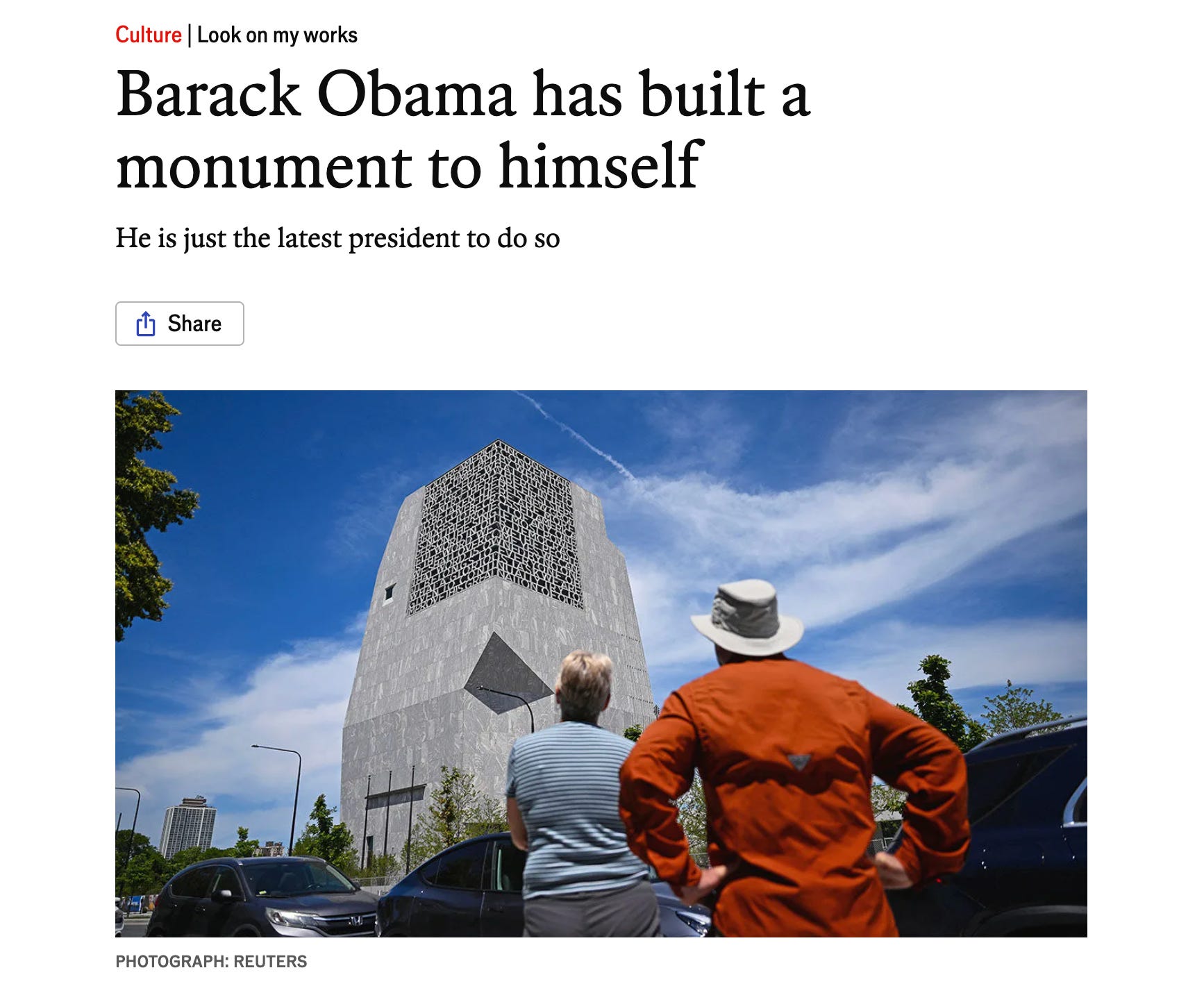
The Economist disappointed me last week. Barack Obama has built a monument to himself?
Not because it criticized the Obama Presidential Center. Criticism is its job. If the editors think the architecture is cold or the building too expensive, they are entitled to say so.
It disappointed me because the headline, the opening paragraphs, and ultimately the article framed the Center as an $850 million monument to Barack Obama.
That is almost the exact opposite of what happened on opening day. And, it certainly isn’t what the Center is about.
After reading the piece, I was left wondering whether the writer had actually listened to the speeches that accompanied the dedication. Or, did he/she actually look at what is at the Center?
President Obama spent remarkably little time talking about himself. Michelle Obama made the same point. They both returned, over and over again, to the same idea that this place was never intended to glorify two people. It was built to remind millions of ordinary Americans that democracy belongs to them.
Three words are carved into the stone.
You Are America.
Not “I Am America.”
Not “Barack Obama.”
You.
That distinction matters.
The Center sits on Chicago’s South Side for a reason. It was not placed among luxury hotels and office towers. It was built in a neighborhood that has too often been overlooked, with the expectation that it will generate jobs, investment, visitors, and opportunity for the surrounding community. It includes public spaces, recreation, educational programming, and a public library branch designed to encourage civic participation, not simply preserve presidential memorabilia.
The building bears Obama’s name.
Its purpose extends far beyond Obama’s presidency.
Nothing illustrated that more clearly than the story President Obama chose to tell.
He spoke about Theodore Parker, the nineteenth century abolitionist minister whose words Martin Luther King Jr. would later make famous.
“The arc of the moral universe is long, but it bends toward justice.”
Most people know the quotation.
Far fewer know its context.
Parker spoke those words after passage of the Fugitive Slave Act. In Boston, escaped slaves who had built new lives in freedom were hunted down, arrested, and marched through the streets under heavy armed guard as thousands watched. They were not strangers. They were neighbors. Shopkeepers. Church members. Men and women whose names people knew. One by one they were forced onto ships that would carry them back into slavery.
Imagine standing on that street.
Imagine watching your neighbor being led away while hundreds of officers made certain there was nothing you could do to stop it.
America appeared to be moving backward, not forward. Justice was nowhere in sight.
Yet Parker refused to surrender to despair.
He said he could not see the entire arc of history. His own life was too short. But he believed that if ordinary people kept pulling toward justice, history would eventually bend in that direction.
As I listened to President Obama tell that story, I realized it was no longer just history.
Today, across America, people are watching neighbors disappear. They are watching the parents of their children’s friends. They are watching classmates vanish from classrooms, coworkers fail to show up for work, and families torn apart in communities where they have lived for years.
And too often, we stand on the sidewalk and watch. Actually, mostly all the time that is what we are doing.
That was Obama’s message.
Hope is not optimism.
Hope is work.
Hope is deciding that history is not something that happened to other people. It is something we are writing every single day.
Hope is in all of us. Now we have to activate it.
Which brings me back to The Economist.
I have been a subscriber for years because I admire rigorous thinking. I expect it to criticize presidents, institutions, governments, companies, and ideas. That is one of the reasons I read it.
But I also expect intellectual consistency.
When Donald Trump has repeatedly used the presidency to advance his personal brand, enrich members of his family, market products, and blur the line between public office and private benefit, I do not recall The Economist leading with a headline suggesting that the United States had become a monument to one man.
Yet when Barack Obama opens a privately funded presidential center and spends the entire dedication explaining that it is not about him but about us, the headline and opening paragraphs frame it as an $850 million monument to Barack Obama.
That feels less like analysis than narrative.
The article spends pages describing the granite, the architecture, the cost, the basketball court, the sledding hill, the reading room, and the politics of presidential libraries.
What it largely ignores is the central message of the opening itself.
Buildings matter.
But buildings derive their meaning from the stories people tell about them.
On opening day, Barack Obama went out of his way to make sure this story was not about Barack Obama.
He made it about citizenship.
He made it about democracy.
He made it about the responsibility each of us carries.
President Obama was never a perfect president. In my view, he often carried the enormous weight of being America’s first Black president, and at times that responsibility made him more cautious than I wished he had been.
But one thing became unmistakably clear during the opening of the Obama Presidential Center.
He refused to make the day about himself.
He insisted on making it about us.
There is a difference.
It is an important one.
And if The Economist missed that, then it missed the entire story. Take a moment to let The Economist know they got it wrong, and we are starting to take action when journalism is coloring outside the lines of fairness. I cancelled my subscription this morning.
*******************************************************************************************************


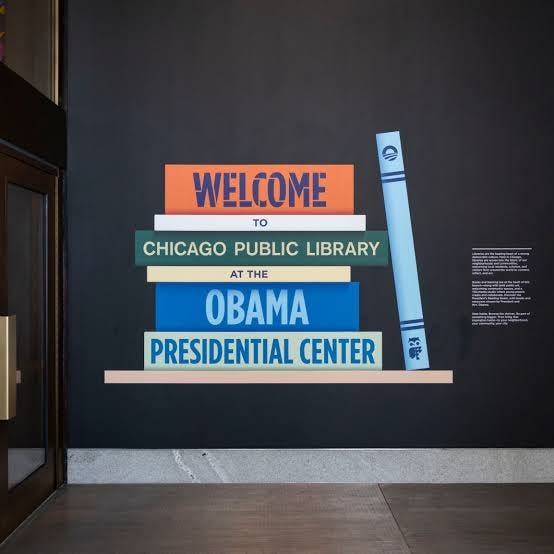
Obama’s favorite exhibit is the room where his letters to Americans are displayed. Every night, he read positive and negative letters written to him by Americans that were curated by his staff. He answered ten every day. But hand. And, here they are.
Well said!
Totally agree! Thanks for making this post.