
The Quiet Return of Separation of Powers?
Six Republicans crossed the aisle yesterday. Time for us to thank them.

“We are getting very good at outrage. What if we got just as good at reinforcing courage?” — Christine Merser
This is the moment. Not sure why it is not on everyone’s feed!
Yesterday, February 11, 2026, the House of Representatives voted 219 to 211 to block President Trump’s 25 percent tariff on Canadian imports. The tariff had been imposed through a national emergency declaration. The resolution does not immediately erase the tariff. The president can veto it. But that is not the point.
The point is that six Republicans voted yes.
Six.
In a political climate where deviation is punished, primaries are weaponized, and loyalty is often valued above constitutional balance, six Republican members of Congress publicly broke with a president of their own party on a defining economic policy.
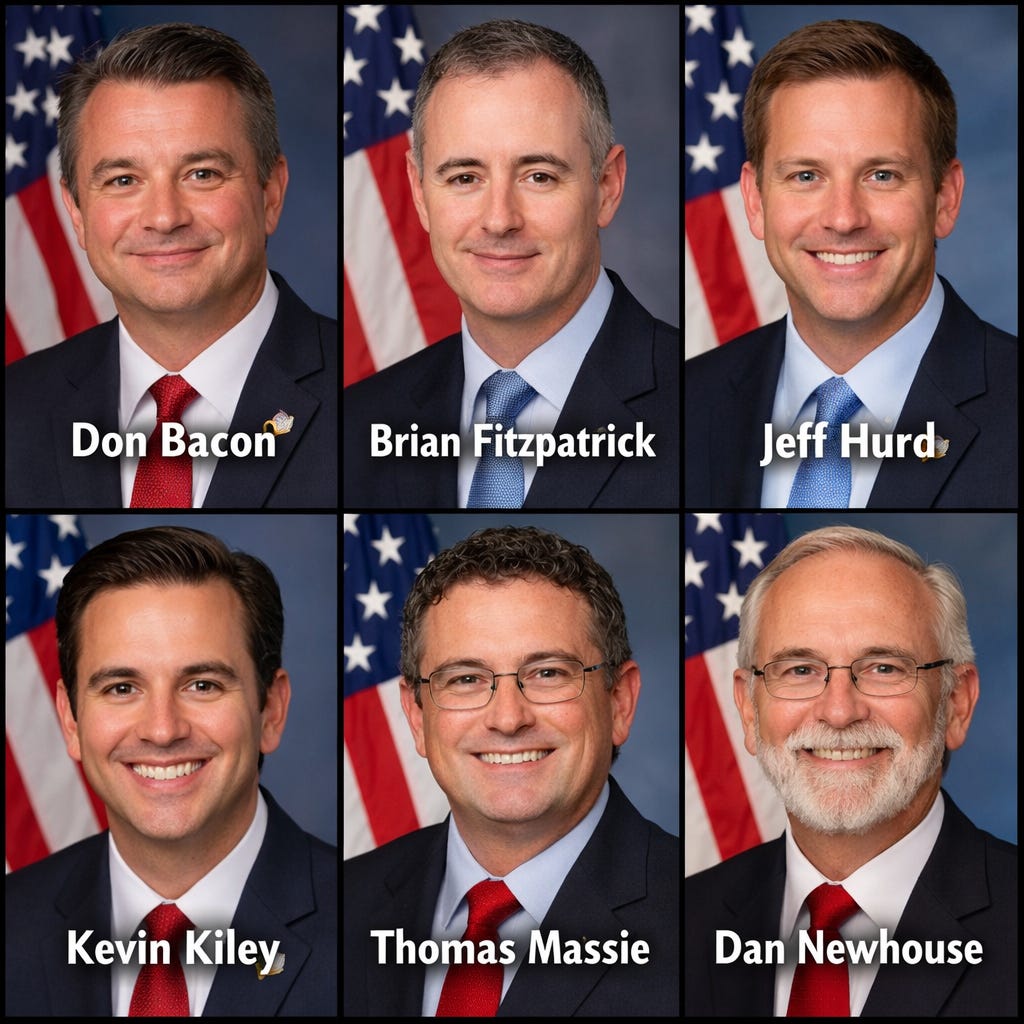
Those members are:
Don Bacon of Nebraska
Brian Fitzpatrick of Pennsylvania
Jeff Hurd of Colorado
Kevin Kiley of California
Thomas Massie of Kentucky
Dan Newhouse of Washington
Every Democrat but one supported the resolution. One Democrat, Jared Golden of Maine, voted no. But the story is not about party arithmetic. It is about something quieter and far more fragile.
It is about separation of powers.
Under Article I of the Constitution, Congress holds the authority over tariffs and trade. Over the last century, that authority has increasingly shifted to the executive branch through emergency statutes. What happened yesterday was not just about Canada. It was Congress asserting, even in a limited and symbolic way, that it still exists.
Canada is our largest trading partner. A 25 percent tariff does not just land on Ottawa. It lands on American farmers, manufacturers, auto plants, lumber yards, and consumers. It raises costs in states that depend on cross border supply chains. For some of the Republicans who voted yes, this is not theoretical. It is personal to their districts.
But make no mistake. This vote required courage.
Breaking with a president who dominates his party invites consequences. It invites primary challenges. It invites the machine. Anyone who believes these men are not being pressured does not understand the moment we are living in.
And yet they voted.
This is the pivot.
For years we have reacted in outrage. We have flashed, burned, shouted, condemned. Some of that was necessary. But outrage alone does not build democratic muscle. It exhausts it.
Positive reinforcement builds muscle.
When members of Congress act to reassert institutional balance, even imperfectly, even symbolically, it is a signal. It is a small opening in a locked room. And history tells us that institutional shifts rarely begin with a landslide. They begin with six.
This is not about elevating them to hero status. It is about recognizing that democracy survives not in sweeping speeches but in roll call votes.
The resolution may face a veto. It may not survive the Senate. It may not change policy tomorrow. But it changed something yesterday.
It showed that dissent inside a party is still possible.
It showed that constitutional authority is still remembered.
It showed that not everyone is willing to surrender congressional power to executive declaration without a fight.
This is where we begin again.
Not with fury.
With recognition.
Six Republicans crossed a line yesterday. Not to defect. To defend a branch of government.
In this climate, that matters.
When leaders step outside the safety of party alignment to uphold institutional balance, it is not weakness. It is strength. It is risk. It is service. Moments like this deserve to be seen. They deserve to be acknowledged. They deserve to be remembered.
If we want a different political future, it begins by recognizing courage when it appears. The more we elevate principle over party, the more space we create for others to do the same.
God bless America.