

Once upon a time, Uncle Sam went to see Grandma. many moons ago, when we weren’t paying attention.
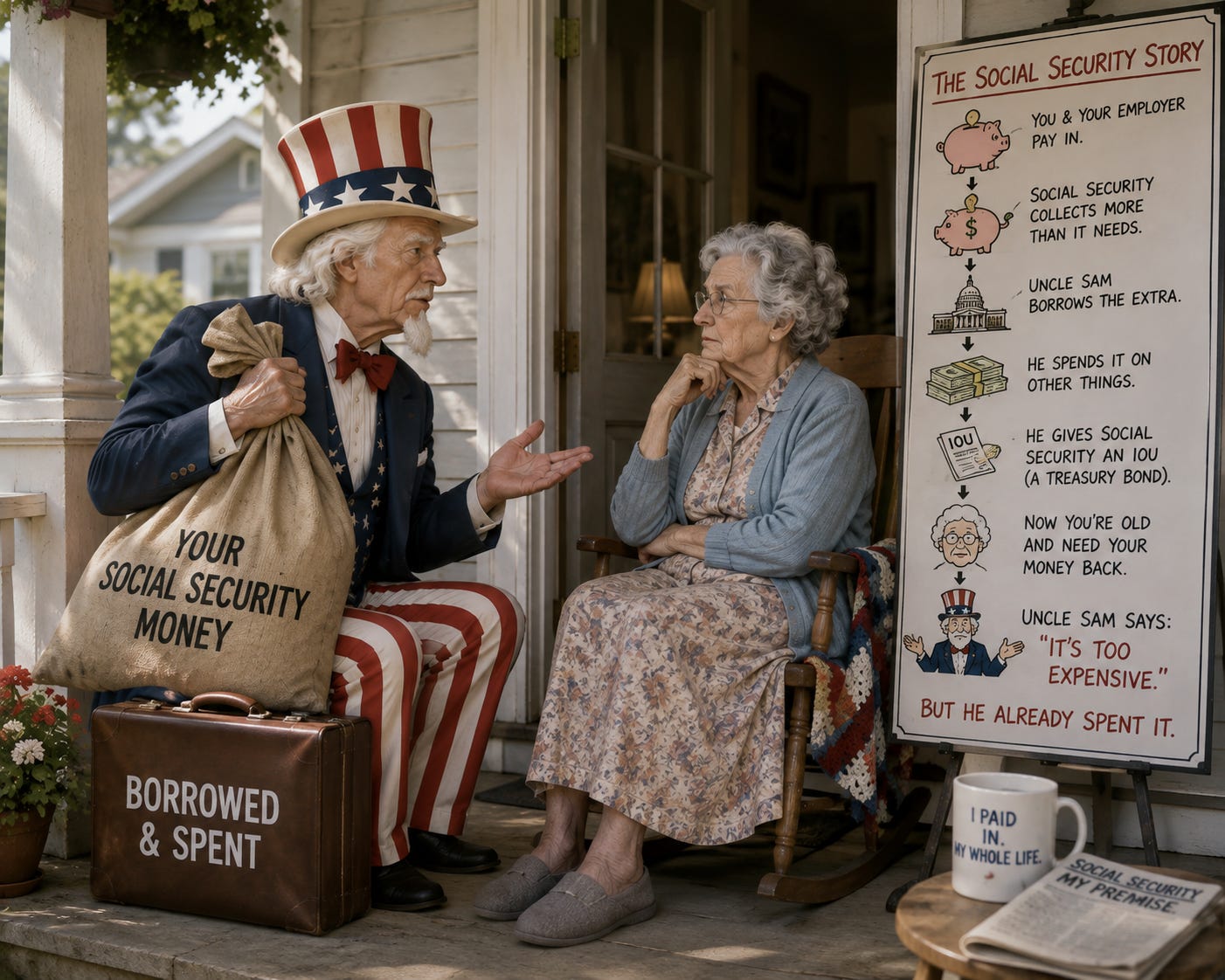
Grandma was not actually his grandmother. She was just an ordinary American who had worked for forty-five years, which in Washington apparently makes you a fiscal category.
“Grandma,” Uncle Sam said, “I have a wonderful idea.”
Grandma had lived long enough to know that when Uncle Sam showed up with a wonderful idea, she should probably hide her wallet.
“What is it?”
“We’re going to create something called Social Security. Every time you get paid, we’ll take some money out of your paycheck. Your employer will put money in too. We’ll keep it safe for you, and when you’re old, you’ll get benefits.”
Grandma said ok, because back then she thought she elected humans that would take care of our country and use her money wisely.
And, because she was 24 and “old” sounded like something that happened to other people.
So she went to work. And every payday, money came out of her check. When she made $100, some went to Social Security. When she made $1,000, some went to Social Security.
When she finally made enough money to buy the good olive oil without waiting for it to go on sale, some went to Social Security.
She did this for decades.
So did millions and millions of other Americans. And something interesting happened. For many years, Social Security collected more money than it needed to pay benefits.
There was a surplus. A very large surplus. Uncle Sam noticed. Uncle Sam always notices money.
One afternoon, he came back to Grandma’s house.
“Grandma?”
“Yes?”
“You know that money you’ve all been putting away?”
“Yes.”
“You’re not using all of it right now.”
“No. That’s rather the point of saving.”
“Exactly! So I was thinking I could borrow the extra.”
Grandma looked at him.
“Borrow?”
“Borrow.”
“You’ll pay it back?”
“Absolutely.”
“With interest?”
“Of course.”
“Is this one of those family loans where Thanksgiving becomes uncomfortable?”
“Grandma. Please. I’m the United States government.”
That did sound reassuring.
So Social Security’s surplus cash was invested in special Treasury securities. The Treasury got the cash to use for the government’s other needs. Social Security got securities backed by the United States government.
In other words, Uncle Sam took the money and left an IOU.
A very official IOU.
It had no coffee stain on it and everything.
This went on for years. Social Security accumulated trillions of dollars in Treasury securities. The Treasury got to use the cash. Everybody was happy.
Then something completely unforeseen happened.
Grandma got old.
Apparently this came as a surprise.
She turned 65. Then 70. Then 75.
And millions of other Americans had the astonishing lack of foresight to do exactly the same thing.
So Social Security began needing more of the money it had accumulated.
Grandma called Uncle Sam.
“Hi, Sam.”
“Grandma! Great to hear from you.”
“I need my money.”
There was a pause.
“What money?”
Grandma looked at the phone.
“The money you borrowed.”
“Ohhhhh. That money.”
“Yes. That money.”
“Well, technically, Grandma, those are Treasury securities.”
“I know. You gave them to me.”
“Yes.”
“Because you borrowed the cash.”
“Yes.”
“And you promised to pay it back.”
“Absolutely.”
“Excellent. I’d like it back.”
Another pause.
Then Uncle Sam cleared his throat.
“Grandma, I think we need to have a serious conversation.”
“About what?”
“Your retirement.”
“What about it?”
“It’s getting very expensive.”
Grandma waited.
“For whom?”
“The federal government.”
Grandma waited some more.
This was not going the way Uncle Sam had hoped.
“You borrowed my money.”
“Yes, but—”
“You spent my money.”
“Well, spent is such an inflammatory word.”
“What word would you prefer?”
“Allocated.”
“You allocated my money.”
“That’s better.”
“And now I would like you to unallocate it back to me.”
“Grandma, the country is facing very difficult fiscal choices.”
There it was.
Difficult choices.
If you live long enough, you learn that whenever Washington announces that “difficult choices must be made,” there is an excellent chance Washington has already decided who will be making them.
And it isn’t Washington.
“Let me understand this,” Grandma said.
“I worked for forty-five years.”
“Yes.”
“I paid Social Security taxes.”
“Yes.”
“My employers paid Social Security taxes.”
“Yes.”
“For years, Social Security collected more than it needed.”
“Yes.”
“You borrowed those surpluses.”
“Yes.”
“You used the cash elsewhere in the federal government.”
“Yes.”
“You gave Social Security Treasury securities promising repayment.”
“Yes.”
“And now that those securities need to be redeemed, you’re telling me that I am expensive?”
“Grandma, you’re oversimplifying a very complicated fiscal situation.”
“No. I think I’ve finally simplified it exactly enough.”
And this is the moment our sweet little fable becomes a horror story.
Because Social Security does face a real financing problem as America ages. Fewer workers support each beneficiary than they once did, and current projections show that the system will eventually be unable to pay every dollar of scheduled benefits unless Congress acts.
That problem is real.
But it does not erase what happened before it.
Social Security was separately financed. Its surpluses were invested in obligations of the United States Treasury. The federal government received and used that cash. Those obligations are real. And redeeming them isn’t Uncle Sam reaching into his pocket and generously giving Grandma a present.
It is Uncle Sam honoring an IOU.
And this is where language matters.
Listen carefully when politicians talk about Social Security. Listen for entitlement. Listen for unsustainable. Listen for fiscal responsibility. And definitely listen for difficult choices.
Because those phrases can make something rather extraordinary disappear.
The creditor becomes the expense. The person holding the IOU becomes the problem, when they are not. The government that borrowed the money is the irresponsible person in the room. Remember that.
And Grandma?
Grandma apparently needs to tighten her belt.
There are many ways Congress could address Social Security’s long-term shortfall. Congress could raise additional revenue. It could change the amount of wages subject to Social Security taxes. It could change benefits. It could raise retirement ages. It could use some combination of those things.
Those are choices. Political choices.
Which means whenever someone tells you Social Security benefits simply have to be cut, there is one very important question to ask.
Why is Grandma the one who has to make the difficult choice?
Because Uncle Sam came to her house. Uncle Sam saw her savings. Uncle Sam borrowed the money. Uncle Sam spent the cash. Uncle Sam left the IOUs.
And now Uncle Sam is standing on Grandma’s porch, holding her IOU in one hand and a pair of scissors in the other.
“Good news, Grandma.”
“What?”
“I figured out how we’re going to solve the problem.”
Grandma stared at the scissors.
“Sam?”
“Yes?”
“Put those down.”
And that is where I’m ending this particular children’s story.
Because unlike Little Red Riding Hood, we don’t yet know whether Grandma gets eaten.
A sad but super-cautionary tale.
And (sadly, again) not a fairy tale