
Why Do We Name Wars After the County Invaded?

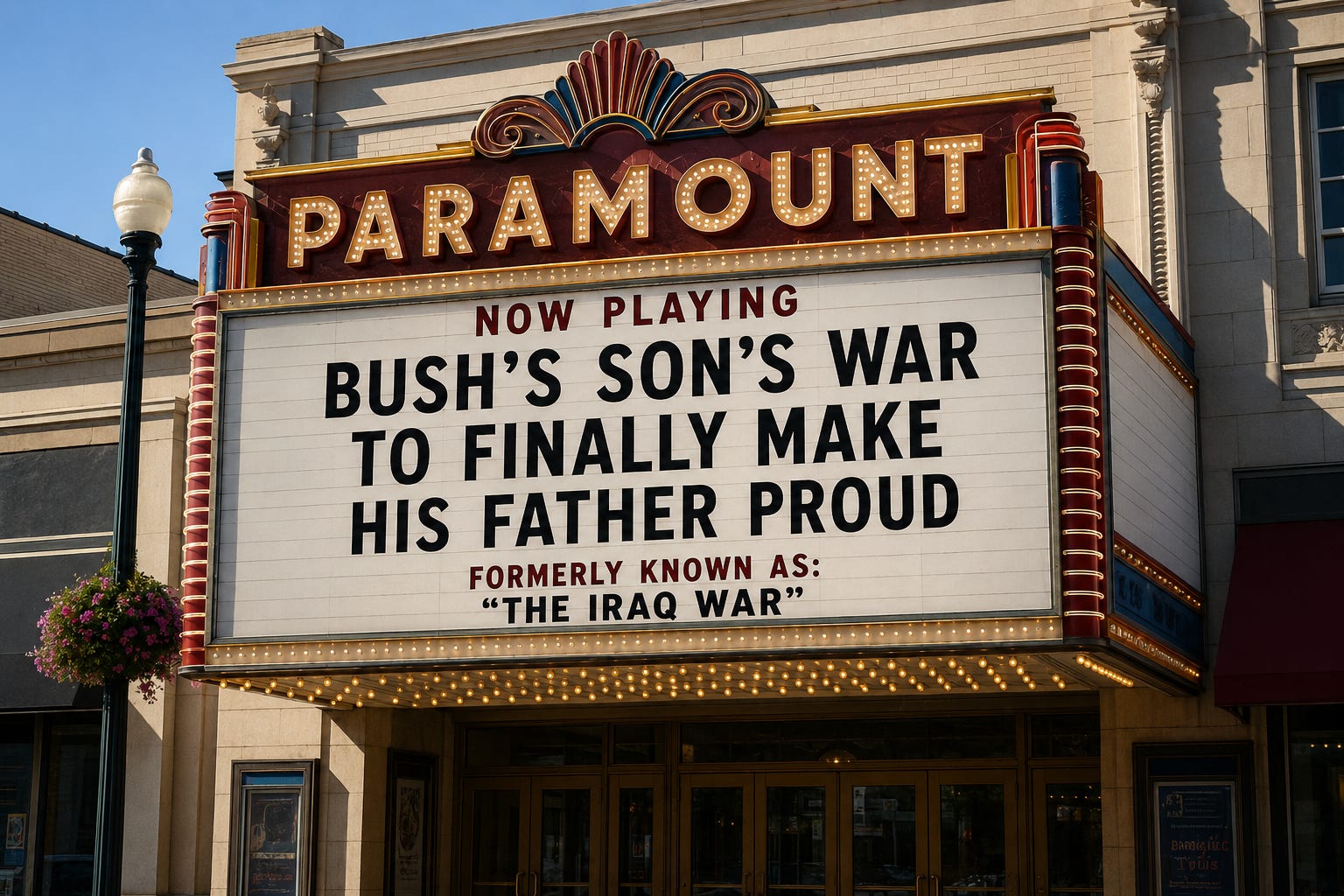
I was thinking about wars the other day and something occurred to me.
We almost always name wars after the country getting bombed instead of the people doing the bombing.
Vietnam War.
Afghanistan War.
Iraq War.
As though those countries simply wandered into the middle of history and accidentally exploded.
It is an interesting little linguistic magic trick.
The active verb disappears.
We do not say:
“America’s Rage Assuagement of 9/11.”
We say, “The Iraq War.”
Which sounds almost mutual. Like Iraq and America got into a disagreement over parking validation instead of one of the most powerful nations on earth invading another country over weapons that did not exist.
Or more accurately, weapons the administration needed the public to believe existed.
And this is where the naming becomes dangerous because once language softens the action, the actual story starts disappearing too.
The vice president of the United States, Dick Cheney, had unfinished emotional business with Saddam Hussein going back to the Gulf War and the moment George H.W. Bush left him in power. Bush Sr. was criticized by some conservatives for not going all the way to Baghdad after Kuwait. Saddam became unfinished business for an entire generation of Republican foreign policy hawks.
Then 9/11 happened.
America was grieving, terrified, furious, and psychologically shattered. The country wanted somewhere to place its rage. And instead of limiting the response to the actual perpetrators, the emotional opening widened into Iraq.
Suddenly intelligence became theater.
“Could.”
“May.”
“We believe.”
“Possible weapons capability.”
Fear filled in the blanks facts could not.
Colin Powell stood before the United Nations holding up diagrams and presentations that now feel almost tragic to revisit. Careers, media outlets, intelligence agencies, and politicians moved in synchronized certainty around weapons that did not exist.
And the American public, still bleeding emotionally from 9/11, followed.
Not because people were stupid. But, maybe because fear rearranges critical thinking.
I am beginning to think that is one of the oldest truths in politics.
And then I started thinking about World War I and World War II.
Those names are fascinating because they sound so organized in retrospect. As though humanity scheduled them in advance.
World War I sounds almost like a trade convention.
World War II sounds like the sequel nobody asked for but the studio financed anyway.
But neither started as a “world war.”
They started exactly the way these things always start. One country. One border. One grievance. One assassination. One “security concern.” One speech about protection and stability and national pride.
Then alliances activate.
Then economies get involved.
Then resources matter.
Then men who will never see a battlefield begin talking about honor.
And suddenly half the planet is on fire.
The assassination of Archduke Franz Ferdinand did not “cause” World War I any more than one dropped match causes a forest to exist.
The forest was already there.
Wars almost never introduce themselves honestly.
They arrive wearing better clothes.
Defense.
Security.
Liberation.
Protection.
National interest.
Stability.
Nobody says, “We are about to destabilize an entire region because powerful people think the upside outweighs the body count.”
And then there are the wars that arrive right on schedule whenever a leader is politically cornered.
Those deserve entirely different titles too.
Because history has a habit of laundering responsibility through language.
And before anybody says this is dramatic, let me remind you of something else we named.
“The Monica Lewinsky Affair.”
Think about that for a second.
A twenty-two-year-old intern becomes the title character while the President of the United States somehow linguistically disappears into the wallpaper.
Not “Bill Clinton’s relationship with a young intern.”
Not “Presidential abuse of power.”
Not even “The Clinton Scandal.”
No.
“The Monica Lewinsky Affair.”
The person with the least institutional power became the headline.
Exactly the same mechanism.
Language redirects accountability.
Over and over and over again.
And maybe that is the real issue here.
Not semantics.
Power.
Who gets named.
Who disappears.
Who becomes the location of the damage instead of the source of it.
We the people should stop accepting the passive language governments and media hand us.
The press should stop allowing the naming of wars after the injured party.
They should stop allowing administrations to workshop language until aggression sounds procedural and civilians sound responsible for their own destruction.
Call things what they are.
“Russia’s invasion of Ukraine.”
“Bush and Cheney’s Iraq invasion.”
“Netanyahu’s destruction of Gaza.”
“Trump’s diversionary bombing campaign.”
History becomes dangerous when language becomes obedient.
And maybe the first responsibility of journalism is not access.
Maybe it is refusing to help power hide behind grammar.
I am so tired of realizing these things so late in the game. But it’s not too late to stop it. It’s not. So, Gaza is the Trump Netanyahu Attack on Gaza. Don’t call it anything else. And, Iran. It’s Trump’s War on Iran. Please. Correct the journalists. One by One. One reference after another.
And, Monica? So very very sorry.
When China refers to the portion of WWII that took place in China (1937-1945, though the Japanese invaded Manchuria in the NE in 1931), the name is 抗日战争 (Kàng-Rì Zhànzhēng). This translates as "War of Resistance Against Japan". There is a museum in Beijing located near the Marco Polo Bridge where this war began in 1937 that is named, Museum of the War of Chinese People's Resistance Against Japanese Aggression.
And by extension, lots of misnomenclature in our interpersonal interactions, as well.
Might be an interesting column...